
Concrete can have sufficient slump and still show poor stability.
A producer may observe:
- Water appearing on the surface
- Paste separating from coarse aggregate
- Stones accumulating at the bottom
- Excess mortar at the top
- A watery layer forming after transport
- Concrete flowing quickly but lacking cohesion
- Pumped concrete showing unstable discharge
These problems are usually described as:
bleeding or segregation.
When they appear after changing a polycarboxylate superplasticizer, the PCE is often blamed immediately.
PCE can certainly influence concrete stability, especially when dosage or compatibility changes.
However, bleeding and segregation are usually controlled by the whole concrete system:
PCE + water + binder + sand + fines + coarse aggregate + air + mixing + temperature.
The correct troubleshooting question is therefore not simply:
“Is the PCE too strong?”
but:
“Why is the mortar phase no longer able to keep water, paste and aggregate distributed uniformly?”
1. What Is Concrete Bleeding?
Bleeding occurs when water moves upward through fresh concrete after placement.
As solid particles settle, part of the mixing water may rise toward the surface.
A small amount of bleeding can occur in some concrete systems.
However, excessive bleeding may produce:
- Surface water
- Weak surface zones
- Uneven finishing
- Water channels
- Reduced uniformity
The severity depends on the mix design and construction conditions.
2. What Is Concrete Segregation?
Segregation means the components of concrete separate instead of remaining uniformly distributed.
Typical forms include:
- Coarse aggregate separating from mortar
- Paste flowing ahead of aggregate
- Water separating from the paste
- Heavy stone settling excessively
Segregation is therefore broader than bleeding.
A mix may bleed without severe coarse-aggregate segregation, or it may segregate with relatively little visible surface water.
3. Why Can High Slump Concrete Still Be Stable?
High slump does not automatically mean segregation.
A well-designed high-flow concrete can maintain:
- Cohesion
- Aggregate suspension
- Uniform paste distribution
while still flowing easily.
The problem begins when flowability increases faster than the system's ability to remain stable.
This is why two concretes with similar slump flow may behave very differently after standing.
4. How Does PCE Affect Concrete Stability?
PCE disperses cementitious particles.
This reduces internal flocculation and allows concrete to flow with less water.
However, if dispersion becomes very strong relative to the available fines and paste structure, the mix may lose cohesion.
The result may be:
- Very rapid flow
- Water separation
- Aggregate settlement
- Paste migration
Therefore, the required PCE dosage must be considered together with mix stability.
5. Can Too Much PCE Cause Bleeding or Segregation?
In some systems, excessive PCE dosage can contribute to instability.
Possible observations include:
- Slump increases sharply
- Mortar becomes too fluid
- Coarse aggregate begins to separate
- Bleeding increases
- Setting becomes slower
However, there is no single universal overdose level.
The response depends on:
- Cement
- Water-binder ratio
- Sand
- Binder content
- PCE structure
Controlled dosage testing is necessary.
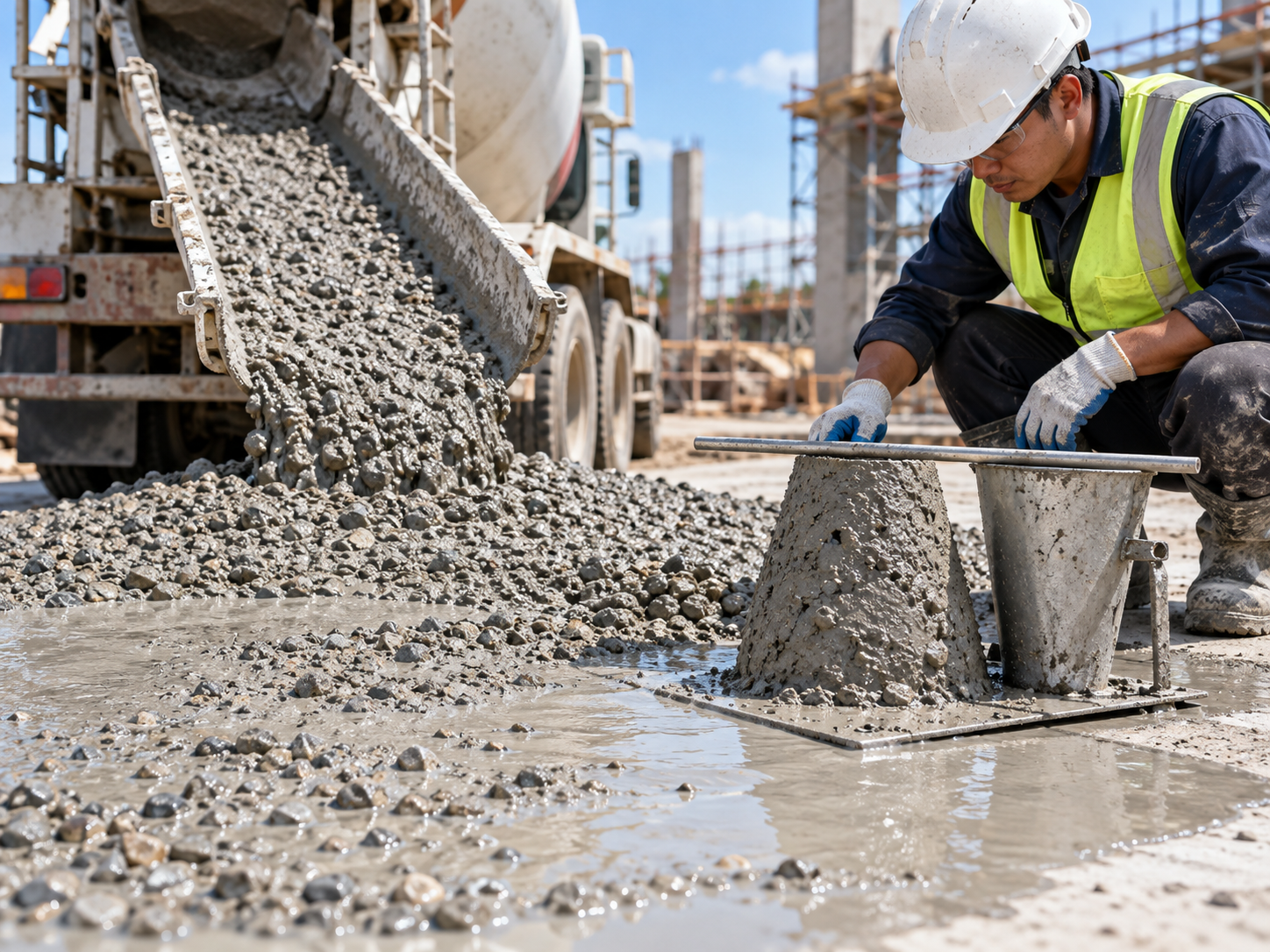
6. Why Does PCE Overdose Not Look the Same in Every Concrete?
Different concrete systems respond differently.
For example, an overdose in one mix may produce:
- Strong bleeding
while another mix may show:
- Segregation without much visible water
and a third may show:
- Excessive retardation.
The final effect depends on the balance between:
- Particle dispersion
- Paste viscosity
- Water content
- Fine-particle volume
This is why PCE dosage should not be judged from slump alone.
7. Why Is Water Content One of the First Things to Check?
Excess water reduces paste concentration.
When water content becomes too high, the mortar phase may not have enough internal structure to support aggregate.
This can increase:
- Bleeding
- Settlement
- Separation
If concrete becomes unstable after a production adjustment, actual water should be checked before increasing or decreasing PCE.
8. Why Can Aggregate Moisture Create a Hidden Water Problem?
Sand and coarse aggregate contain moisture.
If actual moisture is higher than the batching system assumes, additional water enters the mix.
This may cause:
- Higher slump
- Bleeding
- Segregation
The operator may think the PCE became stronger.
In reality, the effective water-binder ratio increased.
Therefore, aggregate moisture correction is essential when concrete stability suddenly changes.
9. Why Is Rainy Weather Often Related to Stability Problems?
During rainy conditions, stockpiled sand can absorb more water.
If moisture correction is not updated frequently, the batch may receive more water than intended.
The result can include:
- Unexpectedly high slump
- Bleeding
- Paste separation
This type of problem can appear suddenly even when:
- Cement is unchanged
- PCE is unchanged
- Mix proportions are unchanged on paper.
10. How Does Sand Grading Influence Segregation?
Sand forms an important part of the internal particle skeleton.
If the sand grading lacks enough intermediate particles, the mortar may not properly fill the spaces around coarse aggregate.
This can reduce cohesion.
Poor sand grading may therefore contribute to:
- Stone settlement
- Paste separation
- Uneven flow
The same PCE dosage may behave normally with one sand and poorly with another.
11. Why Does Insufficient Fine Material Increase Segregation Risk?
Fine particles help provide continuity in the mortar phase.
If a mix contains too few fines, the paste may become too thin to hold coarse aggregate uniformly.
Possible results include:
- Rapid coarse-aggregate settlement
- Water separation
- Harsh mortar
Therefore, excessive removal of fines is not always beneficial.
Concrete stability requires an appropriate particle-size distribution.
12. Does This Mean More Fines Are Always Better?
No.
Too many fines may cause:
- High water demand
- High viscosity
- Increased PCE demand
- Sticky concrete
So the goal is not maximum fines.
It is a suitable balance between:
- Coarse aggregate
- Sand
- Fine particles
- Binder
- Water
This is why concrete stability and concrete viscosity should be considered together.
13. Why Is Manufactured Sand Important?
Manufactured sand may contain:
- Stone powder
- Very fine crushed particles
- Clay contamination
The exact composition can vary significantly.
A manufactured sand with suitable grading and controlled fines may work well.
Another source may create:
- Excess water demand
- PCE demand changes
- Bleeding or stickiness
Therefore, manufactured sand should be evaluated by actual grading and fine-particle characteristics rather than by name alone.
14. Can Too Little Stone Powder Cause Segregation?
In some manufactured-sand systems, reducing stone powder too far can lower mortar cohesion.
This may make the concrete:
- More prone to separation
- Less stable during flow
However, stone powder and clay are not the same.
Useful mineral fines may support packing and cohesion, while clay contamination can interfere with PCE performance.
The two should not be confused.
15. Why Can Clay Cause Both High PCE Demand and Poor Stability?
Clay particles have high surface area and may strongly interact with water and PCE.
This can create a difficult situation.
The plant may increase PCE to recover slump.
But if the mix structure is already unbalanced, the result may become unstable.
Therefore, when:
- PCE demand rises
- Slump becomes difficult to control
- Segregation appears
sand clay content should be investigated.
16. How Does Sand Ratio Affect Concrete Stability?
If sand ratio is too low, there may not be enough mortar to fill spaces between coarse aggregate.
This can cause:
- Harsh concrete
- Stone concentration
- Separation
If sand ratio is too high, the mix may become:
- Sticky
- High in water demand
- High in paste demand
Therefore, sand ratio must be balanced with:
- Aggregate grading
- Binder volume
- Water
- PCE.
17. Why Does Coarse Aggregate Grading Matter?
A well-distributed coarse aggregate skeleton can reduce the amount of mortar required to fill voids.
If coarse aggregate grading is poor, larger void spaces may develop.
Then more mortar is required to maintain stability.
If this adjustment is not made, the concrete may show:
- Local stone concentration
- Segregation
- Difficult pumping
Aggregate grading therefore influences both stability and cost.
18. How Does Maximum Aggregate Size Affect Segregation?
Larger aggregate particles are heavier.
If paste viscosity and mortar cohesion are insufficient, large particles may settle more easily.
This is especially relevant in:
- High-flow concrete
- Pumped concrete
- Mixes with low fine-particle content
The aggregate size should therefore be compatible with the paste and mortar system.
19. Why Does Binder Content Influence Bleeding?
Binder particles help form the paste phase.
If binder content is too low relative to water and aggregate, paste may not provide enough cohesion.
This can increase bleeding or separation.
However, simply increasing cement is not always the correct solution because it may also increase:
- Cost
- Heat
- Shrinkage
Particle grading and supplementary materials should also be considered.
20. Can Fly Ash Help Reduce Bleeding?
In some formulations, fine fly ash can increase the fine-particle volume and modify paste structure.
This may reduce bleeding.
However, the actual effect depends on:
- Fly ash fineness
- Carbon content
- Particle shape
- Replacement level
Different fly ash sources can behave differently.
Therefore, a fixed assumption should not be applied to every product.
21. How Does Slag Affect Stability?
Slag changes:
- Total binder surface area
- Paste volume
- Water demand
- Rheology
Depending on its fineness and dosage, it may influence concrete stability.
If slag source or replacement ratio changes, the existing PCE dosage may need to be checked again.
22. What About Limestone Powder?
Fine limestone powder can participate in particle packing.
In some concrete systems, it may help provide:
- Additional fine-particle volume
- Mortar continuity
But excessive powder can also increase:
- Water demand
- Viscosity
Therefore, the appropriate amount depends on the complete mix.
23. Why Does Silica Fume Usually Reduce Bleeding?
Silica fume has very fine particles and high surface area.
It tends to increase paste cohesiveness and water demand.
For this reason, silica-fume-containing concrete often shows relatively little bleeding.
However, the same property can also make the mix:
- More viscous
- More difficult to pump
So reducing bleeding should not be considered in isolation from workability.
24. Why Is Concrete Stability a Balance Between Viscosity and Flow?
If paste viscosity is too low:
- Bleeding
- Segregation
may increase.
If viscosity is too high:
- Concrete becomes sticky
- Pumping resistance rises
The desired condition lies between these extremes.
PCE dosage should therefore be optimized together with:
- Water
- Sand
- Fines
- Binder
rather than used to control flow independently.
25. Can Slump-Retaining PCE Influence Segregation?
Yes, depending on the system.
Slump-retaining PCE changes the time-dependent dispersion behavior of concrete.
If a formulation releases dispersion gradually, the concrete may become more fluid later.
This means a mix that looks stable initially may show:
- Increased slump
- Reduced cohesion
after 30 or 60 minutes if the formulation is not balanced.
Therefore, stability should be checked over time.
26. Why Can Concrete Become More Fluid During Transport?
Some PCE systems may continue developing dispersion after mixing.
At the same time:
- Mixing continues in the truck
- Temperature changes
- Cement chemistry develops
The result may be a concrete that arrives with greater flow than expected.
If the paste structure cannot support this flow, segregation may become more visible at discharge.
27. Why Should 0-, 30-, 60- and 90-Minute Stability Be Observed?
Initial concrete condition is only one point in time.
A useful test can monitor:
- Initial slump
- Initial bleeding
- 30-minute stability
- 60-minute stability
- Later workability where required
This helps identify:
- Immediate overdosage
- Delayed flow increase
- Progressive bleeding
- Time-dependent segregation
28. Can Sodium Gluconate Affect Bleeding or Segregation?
Sodium gluconate is used in some admixture formulations to influence early hydration and setting.
If its dosage is increased significantly, the concrete may remain fluid for longer.
In an already unstable mix, extended fluidity can make separation more visible.
However, sodium gluconate should not automatically be identified as the direct cause.
The full formulation should be reviewed.
29. Why Can Excessive Retardation Increase Stability Problems?
If setting is substantially delayed, the concrete stays plastic for a longer time.
This gives particles more time to:
- Settle
- Migrate
- Separate
If paste cohesion is insufficient, prolonged plasticity may make bleeding or sedimentation more noticeable.
So setting behavior and stability should sometimes be evaluated together.
30. Does Air Content Influence Bleeding?
Yes.
Small, stable air bubbles can influence fresh-concrete rheology.
Depending on the system, they may improve:
- Cohesion
- Workability
But excessive or unstable air can create other performance issues.
Therefore, if:
- Defoamer
- Air-entraining component
changes, concrete stability should be rechecked.
31. Can Too Much Defoamer Increase Bleeding?
Potentially, depending on the formulation.
If a system originally contains beneficial fine air and excessive defoamer removes too much of it, the fresh-mortar structure may change.
This does not mean that defoamer is always harmful.
The point is that air control should be optimized rather than maximized.
32. Why Is Mixer Efficiency Relevant?
Poor mixing can create temporary non-uniformity.
If PCE and water are not distributed evenly, one portion of the batch may be:
- More fluid
while another is:
- Stiffer.
This can appear as instability at discharge.
Therefore, when a segregation problem appears intermittently, mixer condition and mixing time should also be checked.
33. Can Incorrect Admixture Addition Sequence Affect Stability?
Yes.
The timing of:
- Water
- PCE
- Other liquid components
can influence early dispersion.
A different addition sequence may produce a different concrete response even when total dosage remains unchanged.
For troubleshooting, batching sequence should be kept consistent.
34. Why Can Recycled Water Change Bleeding Behavior?
Recycled water can contain:
- Suspended fines
- Dissolved ions
- Residual admixture components
These may change:
- Water demand
- Cement hydration
- PCE response
- Paste structure
If recycled water quality varies, concrete stability may vary even with the same nominal mix design.
Therefore, water source is another possible troubleshooting variable.
35. Why Is Pumped Concrete Particularly Sensitive to Segregation?
Pumped concrete needs sufficient mortar to:
- Lubricate the pipe
- Carry coarse aggregate
If the mixture separates:
- Coarse aggregate may concentrate
- Pump pressure may fluctuate
- Blockage risk may increase
Therefore, a mix that looks acceptable in a slump test may still perform poorly in pumping if its internal stability is insufficient.
36. Why Can a Mix Segregate After Pumping Even If It Looked Stable Before?
Pumping subjects concrete to:
- Pressure
- Shear
- Movement through bends and pipes
An unstable mixture may change under these conditions.
This is why production-scale pump trials are valuable for difficult concrete systems.
Laboratory slump alone cannot reproduce the full pumping process.
37. How Can Bleeding Be Distinguished from Excess Surface Water Added at Site?
If workers add water after delivery, surface water may appear for a different reason.
Therefore, investigation should confirm:
- Batch water
- Aggregate moisture
- Site water addition
before concluding that the admixture caused bleeding.
Any uncontrolled water addition makes technical diagnosis more difficult.
38. What Is a Practical Troubleshooting Order?
When bleeding or segregation appears, a practical sequence is:
Step 1: Check actual water
Review batch water and aggregate moisture.
Step 2: Check PCE dosage
Confirm weighing accuracy and recent dosage changes.
Step 3: Check sand
Review grading, fines and clay content.
Step 4: Check binder composition
Look for changes in cement, fly ash, slag or limestone powder.
Step 5: Check aggregate grading
Confirm sand ratio and coarse-aggregate distribution.
Step 6: Check other admixture components
Including slump-retaining components, retarders and defoamers.
Step 7: Repeat a controlled laboratory trial
Change only one variable at a time.
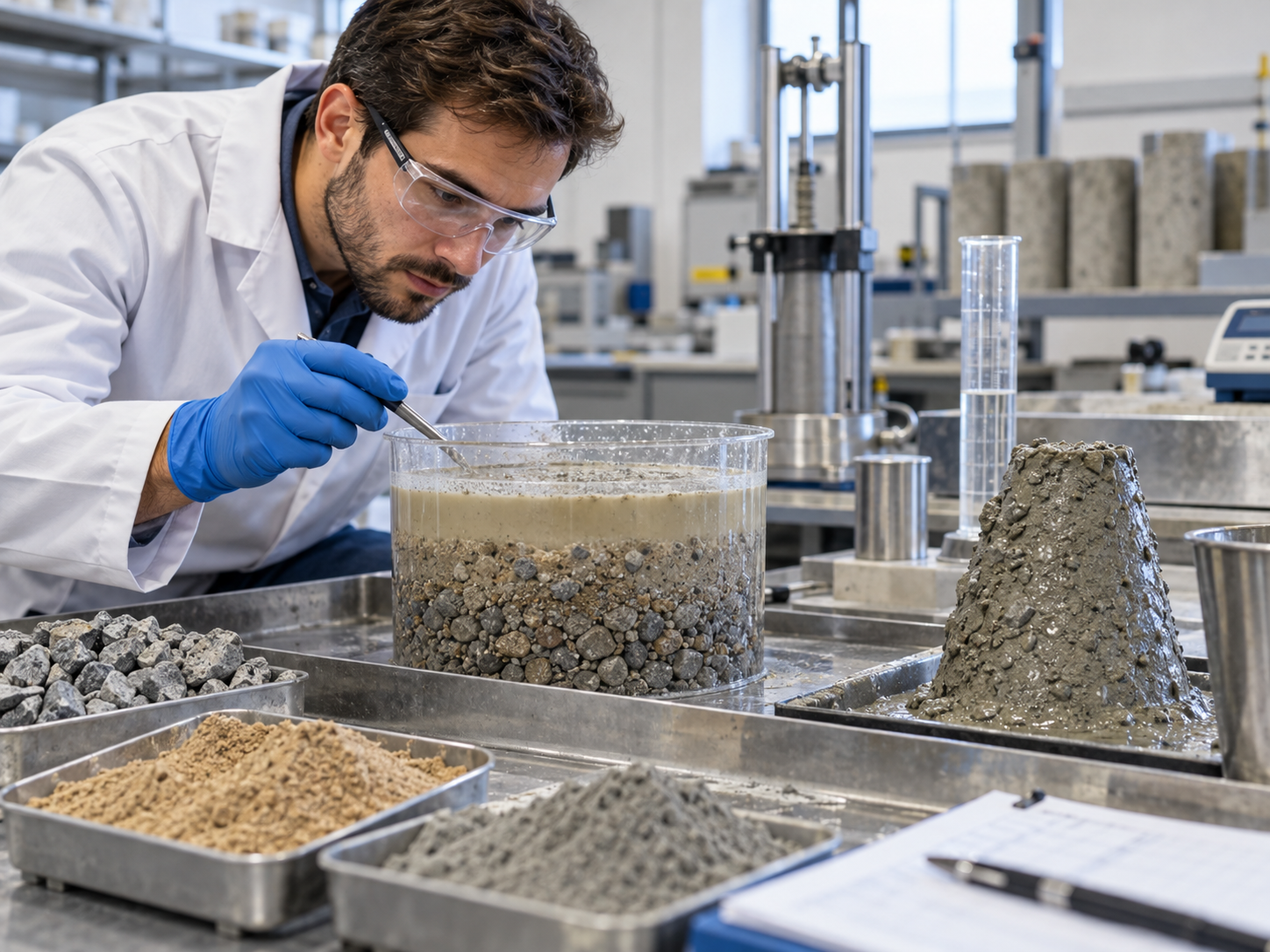
39. How Should a PCE Dosage Trial Be Performed for an Unstable Mix?
Keep the base mix constant.
Use several PCE levels:
lower dosage → current dosage → slightly higher dosage
Then compare:
- Initial slump
- Slump flow
- Bleeding
- Segregation
- Aggregate settlement
- 30- and 60-minute condition
The objective is not simply to find the highest flow.
It is to find a range where flow and stability remain balanced.
40. What If Lowering PCE Reduces Segregation but Slump Becomes Too Low?
This suggests that the problem may not be solved by PCE dosage alone.
Other options to investigate include:
- Actual water
- Sand grading
- Fine-particle volume
- Binder composition
- PCE type
The goal is not to force the entire stability problem into the admixture dosage.
41. What If the Sand Is the Main Cause?
If sand grading or fine content has changed, possible adjustments may include:
- Restoring a more suitable grading
- Adjusting sand ratio
- Reviewing total fines
- Rechecking water
- Re-optimizing PCE dosage
The appropriate response depends on the actual material data.
42. What If Excess Water Is the Main Cause?
The batching system should first correct:
- Sand moisture
- Aggregate moisture
- Added water
Then the original PCE dosage can be retested.
Reducing PCE before correcting excess water may produce the wrong conclusion.
43. Why Should One Variable Be Changed at a Time?
If one trial changes:
- PCE
- Water
- Sand ratio
- Retarder
simultaneously, the cause of improvement becomes unclear.
A more useful method is:
change one variable → test → record → compare.
This creates a repeatable troubleshooting process.
44. What Data Should Be Recorded?
Useful information includes:
- Cement batch
- Supplementary materials
- Sand source
- Sand grading
- Aggregate moisture
- Water-binder ratio
- PCE dosage
- Other admixture components
- Initial slump
- 30-minute slump
- Bleeding
- Segregation
- Concrete temperature
This makes future troubleshooting much easier.
45. What Should Buyers Tell a PCE Supplier When Concrete Segregates?
Instead of saying only:
“Your PCE causes segregation.”
provide:
- Cement type
- Binder composition
- Water-binder ratio
- Sand type
- Fines or clay information
- PCE dosage
- Initial slump
- Slump-retention requirement
- Bleeding condition
- Temperature
This gives the supplier enough context to evaluate whether the issue may be related to:
- Dosage
- PCE type
- Cement compatibility
- Mix design.
Frequently Asked Questions
Can PCE cause concrete segregation?
In some mixes, excessive dispersion or unsuitable dosage may contribute to segregation, but water, sand grading, fines and aggregate proportions should also be checked.
Why does concrete bleed after increasing PCE dosage?
The higher dosage may increase fluidity beyond the available paste cohesion, especially if water content is also high.
Is high slump always more likely to segregate?
No. Properly proportioned high-flow concrete can remain stable. Stability depends on the complete particle and paste system.
Can manufactured sand cause segregation?
Yes, if its grading, fines or clay content are unsuitable for the mix. Manufactured sand itself is not automatically a problem.
Can too little fines increase bleeding?
In some concrete systems, insufficient fine material can reduce paste cohesion and increase separation.
Can too many fines also cause problems?
Yes. Excess fines can increase water demand, viscosity and PCE demand.
Why does concrete look stable initially but segregate after 60 minutes?
Possible causes include delayed PCE dispersion, slump-retaining components, temperature effects or prolonged retardation.
Should PCE dosage be reduced immediately when segregation occurs?
Not before checking actual water and aggregate moisture. Excess water can create the same symptom.
Conclusion
Concrete bleeding and segregation are stability problems, not simply “PCE problems.”
They usually result from the balance between:
dispersion + water + fines + paste volume + sand grading + aggregate skeleton + time-dependent admixture behavior.
A practical troubleshooting sequence is:
check water → check aggregate moisture → check PCE dosage → check sand and fines → check binder → observe stability over time → change one variable at a time.
The objective is not to produce the highest possible slump.
It is to produce concrete that remains:
- Flowable
- Cohesive
- Uniform
- Suitable for transport, pumping and placement
under the actual project conditions.
Shenyang Xingzhenghe Chemical Co., Ltd. supplies polycarboxylate superplasticizer and related concrete-admixture materials. Product specifications, samples and technical information can be provided according to customer requirements. Final product type and dosage should be confirmed through trial testing with the customer's actual cement, aggregates, water and mix design.