
Concrete Admixtures: Why Different Chemicals Have Different Functions
Modern concrete is more than a mixture of cement, aggregates and water.
Depending on the concrete design and construction requirements, chemical admixtures may be introduced to modify properties such as:
- water demand;
- initial workability;
- slump retention;
- setting time;
- dispersion of cement particles;
- pumping and placement behavior.
However, the term "concrete admixture" covers many different types of chemicals.
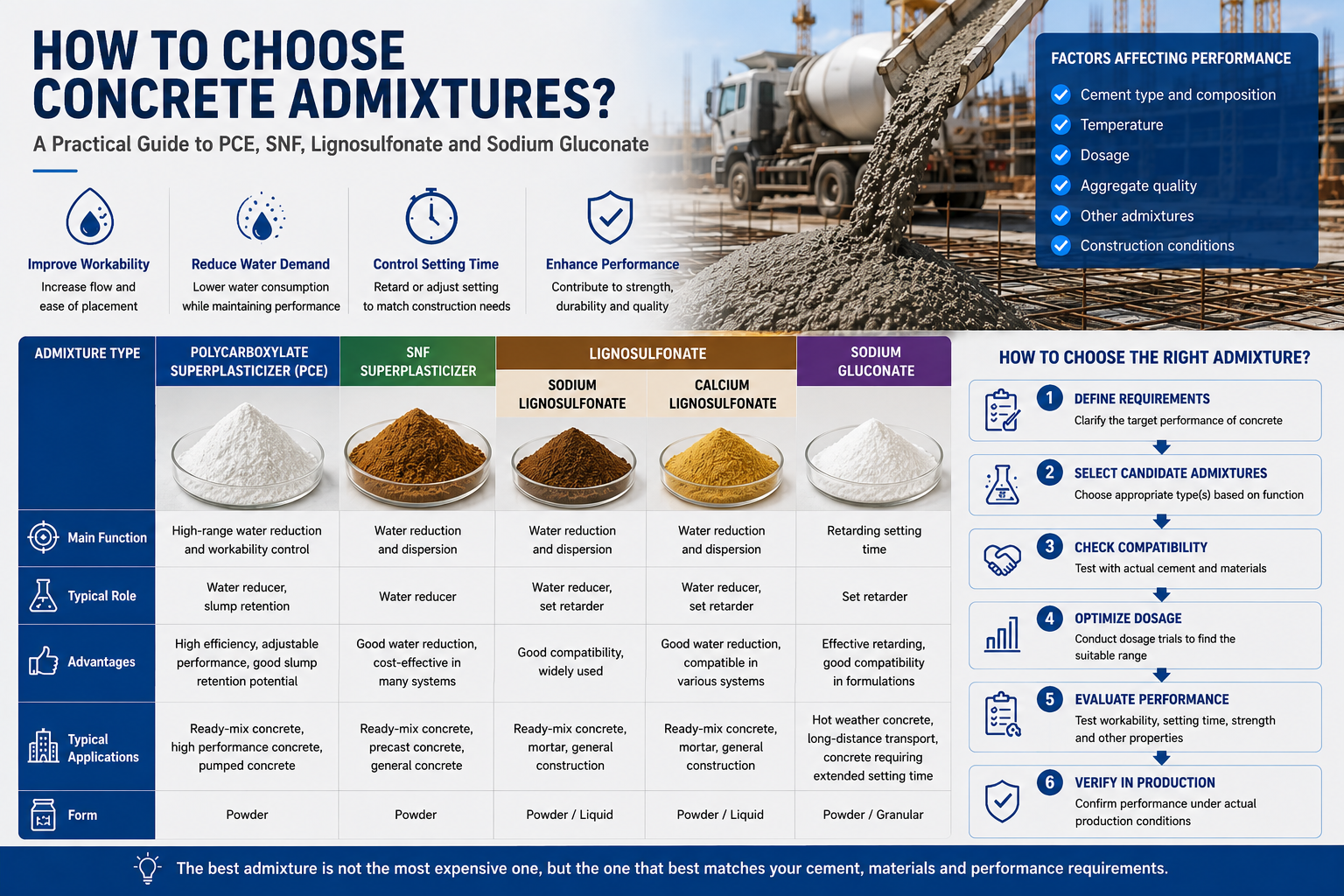
Polycarboxylate superplasticizer (PCE), sulfonated naphthalene formaldehyde (SNF), lignosulfonates and sodium gluconate, for example, can all be found in concrete-related applications, but they do not perform the same function.
Understanding these differences is important when selecting raw materials for a concrete admixture formulation.
1. What Are Concrete Admixtures?
Concrete admixtures are materials added during concrete production to modify one or more properties of fresh or hardened concrete.
Depending on the required performance, admixtures may be designed to influence:
- water reduction;
- workability;
- setting time;
- air content;
- slump retention;
- early-age behavior;
- other properties.
Some products are supplied as finished admixtures.
Others are raw materials used by admixture formulators to produce finished products.
This distinction is important.
For example, PCE may be supplied as a polymer solution or powder, while sodium gluconate may be incorporated as one component of a formulated admixture.
2. What Is a Concrete Water Reducer?
A water-reducing admixture is used to reduce the amount of mixing water required to achieve a specified level of concrete workability.
In simple terms, cement particles naturally tend to form agglomerates when mixed with water.
Certain dispersing chemicals can modify interactions between cement particles and improve their dispersion.
This allows a concrete mixture to obtain the required flow characteristics with a different water demand.
Several chemical families have historically been used for this purpose, including:
- lignosulfonates;
- naphthalene-based superplasticizers;
- polycarboxylate-based superplasticizers.
However, their molecular structures and performance characteristics differ considerably.
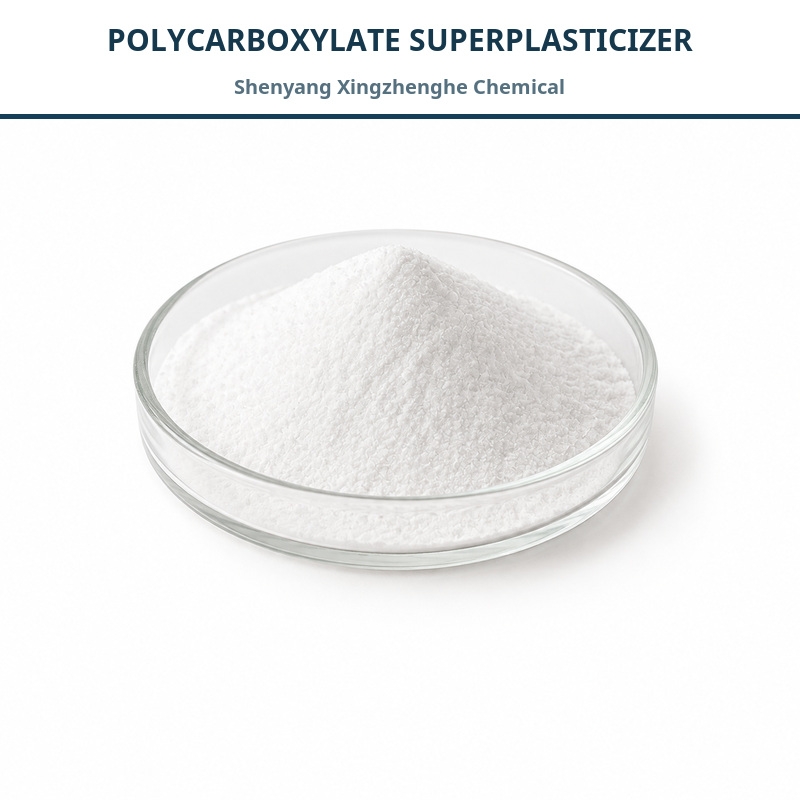
3. What Is Polycarboxylate Superplasticizer (PCE)?
Polycarboxylate superplasticizer, commonly abbreviated as PCE, is a type of polymer-based water-reducing admixture.
Its molecular structure typically contains a polymer backbone and side chains.
The interaction between the polymer and cement particles contributes to particle dispersion.
PCE technology is widely used in various concrete formulations where water reduction and workability control are required.
Depending on polymer design, different PCE products can be formulated with different performance priorities.
4. Water-Reducing PCE and Slump-Retaining PCE Are Not the Same
One important point when selecting PCE is that not every polycarboxylate polymer is designed for exactly the same purpose.
Some PCE products place greater emphasis on:
initial dispersion and water reduction.
Others are designed to contribute more strongly to:
workability retention over time.
Formulators may also combine different PCE components to obtain a balance between initial fluidity and slump retention.
Therefore, asking only:
"What is the solid content of the PCE?"
is usually not sufficient for product selection.
The intended concrete performance should be defined first.
5. What Is SNF Superplasticizer?
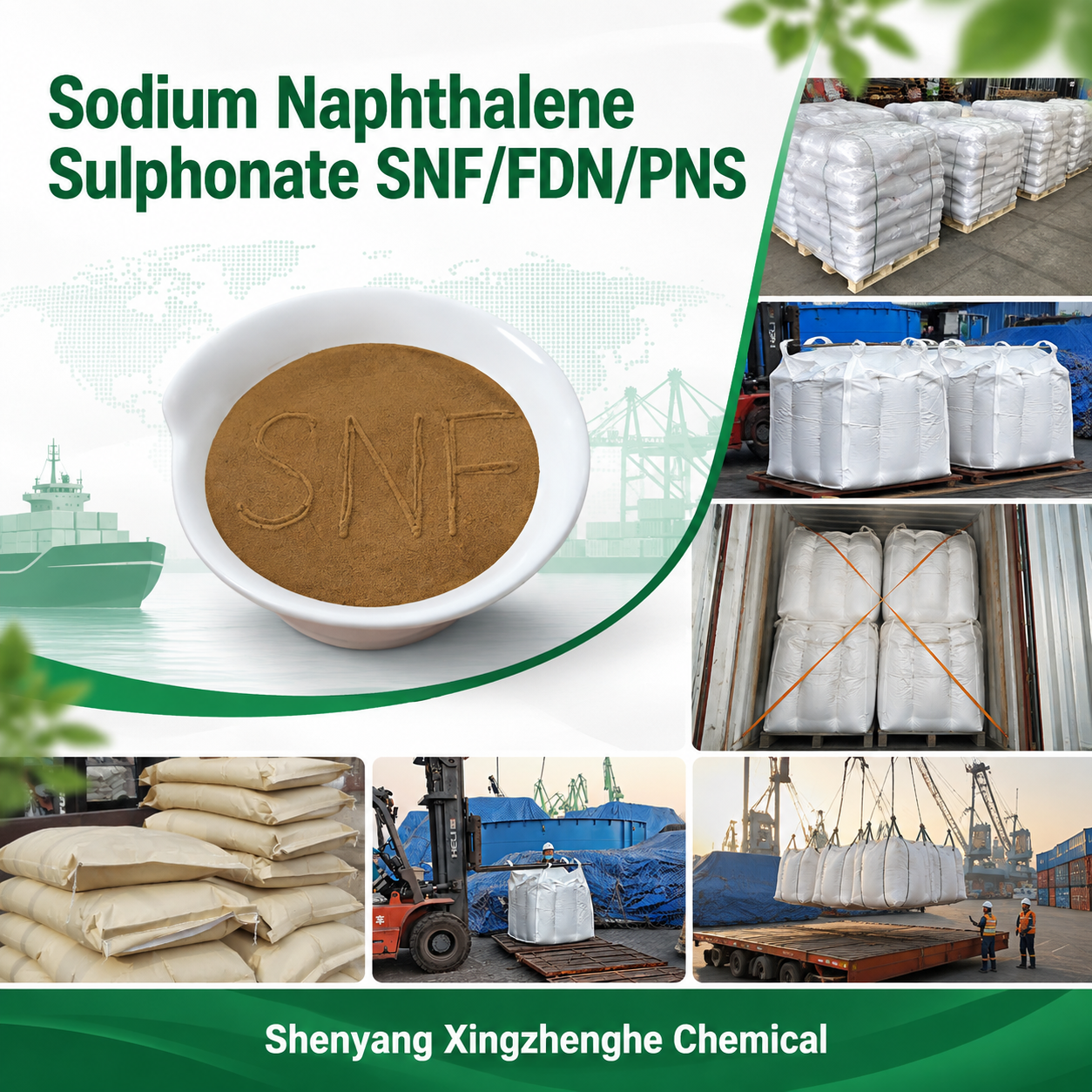
SNF commonly refers to Sulfonated Naphthalene Formaldehyde Condensate, also known as a naphthalene-based superplasticizer.
It belongs to an earlier generation of high-range water-reducing admixtures and is still used in various cement and concrete applications.
SNF improves dispersion primarily through adsorption and electrostatic effects in the cement system.
It is available in different forms and specifications depending on manufacturing and application requirements.
6. PCE vs SNF: What Is the Difference?
PCE and SNF can both function as water-reducing admixtures, but they are chemically different.
| Property | PCE | SNF |
|---|---|---|
| Chemical family | Polycarboxylate polymer | Naphthalene sulfonate condensate |
| Main application direction | Water reduction and workability control | Water reduction and dispersion |
| Dispersion mechanism | Includes steric effects | Mainly electrostatic effects |
| Formulation flexibility | Depends strongly on polymer design | Depends on grade and formulation |
| Cement compatibility | Requires testing | Requires testing |
It would be inaccurate to say that one material is universally suitable for every concrete system.
Selection depends on:
- cement;
- supplementary cementitious materials;
- aggregates;
- concrete design;
- temperature;
- required workability;
- local production conditions.
7. What Are Lignosulfonates?
Lignosulfonates are water-soluble derivatives associated with lignin processing.
Common commercial forms include:
- sodium lignosulfonate;
- calcium lignosulfonate;
- magnesium lignosulfonate;
- ammonium lignosulfonate;
- potassium lignosulfonate.
Different counterions and production processes result in products with different characteristics.
In cement-related applications, certain lignosulfonates have historically been used for their dispersing and water-reducing properties.
8. Sodium Lignosulfonate in Concrete
Sodium lignosulfonate can be used in certain concrete admixture formulations.
Its functions may include effects on:
- cement dispersion;
- water demand;
- setting behavior;
- fresh concrete properties.
However, lignosulfonate products from different sources should not automatically be considered equivalent.
Their performance can be influenced by:
- molecular distribution;
- sugar content;
- inorganic salt content;
- pH;
- production process;
- dosage.
Application testing is therefore important when changing lignosulfonate sources.
9. Calcium Lignosulfonate in Concrete
Calcium lignosulfonate is another lignosulfonate form used in various industrial applications, including certain cement-related systems.
As with sodium lignosulfonate, its actual behavior depends on both product characteristics and the concrete formulation.
The terms "sodium lignosulfonate" and "calcium lignosulfonate" should therefore not be treated as two names for exactly the same product.
The counterion is different, and individual commercial grades can also vary.
10. PCE vs Lignosulfonate: Are They Interchangeable?
Not directly.
Both materials can influence cement dispersion, but their chemistry and performance characteristics are different.
PCE is a synthetic polymer whose molecular architecture can be adjusted during production.
Lignosulfonate is derived from lignin-related industrial processing and has a different molecular structure.
Their:
- water-reducing behavior;
- dosage;
- setting effects;
- cement compatibility;
- workability behavior
can differ.
A formulation using lignosulfonate should therefore not be converted to PCE—or vice versa—simply by replacing one material with the same weight of the other.
11. What Is Sodium Gluconate Used for in Concrete?
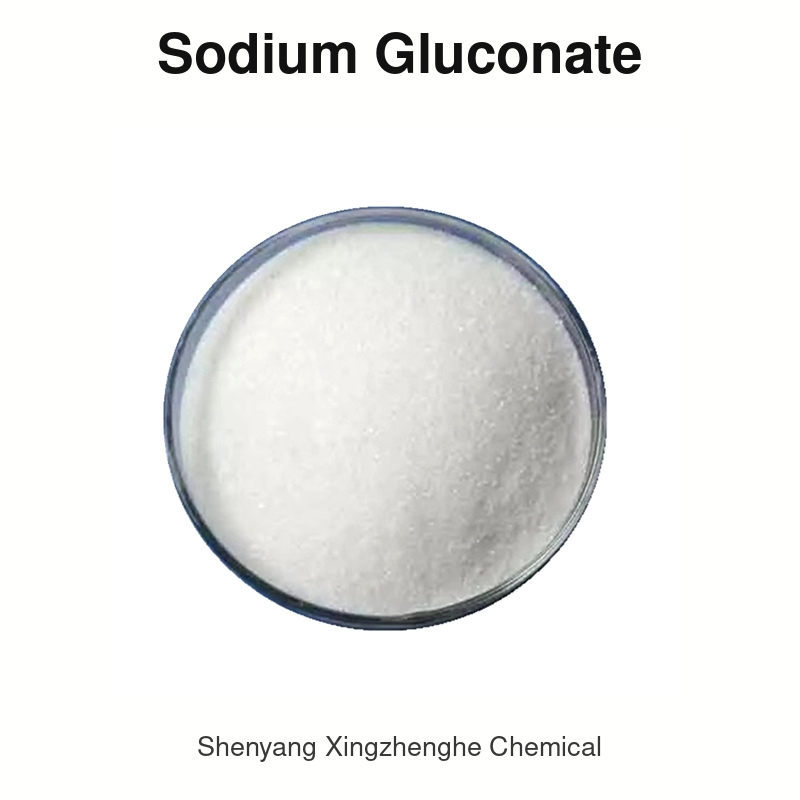
Sodium gluconate is the sodium salt of gluconic acid.
In concrete admixture formulations, it is commonly considered when setting-time control is required.
Its interaction with ions and cement hydration processes can influence the rate at which certain hydration reactions proceed.
As a result, sodium gluconate may be incorporated into formulations where retarding behavior is required.
However, sodium gluconate is not the same type of material as PCE or SNF.
12. Is Sodium Gluconate a Water Reducer?
Sodium gluconate should not simply be treated as a direct substitute for a high-range water reducer such as PCE or SNF.
Its primary purpose in many concrete admixture formulations is associated with hydration and setting-time control.
A formulated admixture may contain both:
a water-reducing component + a retarding component.
For example, a formulator may evaluate a PCE system together with sodium gluconate when both workability and setting behavior need to be controlled.
The appropriate combination depends on the concrete system.
13. Retarding and Slump Retention Are Different
This distinction is important when formulating concrete admixtures.
Retarding
Primarily relates to the timing of concrete setting.
Slump Retention
Relates to how concrete workability changes over time.
A chemical that delays cement hydration may influence concrete behavior over time, but this does not mean that retarding effect and slump-retaining performance are identical.
Both should be evaluated separately.
14. Why Does Cement Compatibility Matter?
Concrete admixtures interact directly with a complex mineral system.
Different cements may vary in:
- clinker composition;
- C₃A content;
- sulfate balance;
- gypsum form;
- fineness;
- alkali content;
- supplementary materials.
For this reason, the same admixture dosage can behave differently with two cement sources.
A PCE that provides a particular flow behavior with Cement A may show different adsorption or workability behavior with Cement B.
The same principle applies to SNF, lignosulfonates and retarding components.
15. Why Does Clay in Sand Matter?
Aggregate quality can also affect chemical admixture performance.
Certain clay minerals in sand can interact with admixture molecules.
This is particularly relevant when evaluating polycarboxylate-based systems.
If the aggregate source changes and concrete suddenly shows different admixture demand or slump behavior, it may be necessary to check:
- clay content;
- aggregate grading;
- moisture;
- fines content.
The admixture itself should not automatically be assumed to be the only cause.
16. How Does Temperature Affect Concrete Admixtures?
Temperature affects cement hydration, evaporation and concrete workability.
At higher temperatures:
- cement hydration may proceed faster;
- evaporation can increase;
- workability may change more rapidly;
- setting behavior can shift.
Therefore, an admixture formulation developed at moderate laboratory temperature may require additional verification for hot-weather concreting.
Similarly, low-temperature conditions present different requirements.
17. Can PCE and Sodium Gluconate Be Used Together?
They can be evaluated together in formulated concrete admixtures because they serve different primary functions.
PCE mainly contributes to cement dispersion and water reduction, while sodium gluconate may be used to modify hydration and setting behavior.
However, there is no universal ratio.
The formulation needs to consider:
- PCE type;
- PCE solid content;
- cement;
- sodium gluconate dosage;
- required setting time;
- required slump retention;
- temperature;
- supplementary cementitious materials.
Laboratory and concrete trials should be used to determine an appropriate formulation.
18. Can Different Water Reducers Be Blended?
Concrete admixture formulation sometimes involves combining components to obtain a targeted performance profile.
However, compatibility cannot be assumed simply because two products are individually used in concrete.
When considering a blend, evaluate:
- solution compatibility;
- storage stability;
- cement compatibility;
- initial workability;
- slump retention;
- setting time;
- air content;
- strength development.
Changing several components simultaneously can make troubleshooting difficult.
For formulation development, controlled comparative testing is generally more informative.
19. What Should Be Checked When Selecting PCE?
For polycarboxylate superplasticizer, selection should go beyond appearance and solid content.
Depending on the grade, useful information may include:
- physical form;
- solid content;
- density;
- pH;
- intended performance direction;
- recommended application;
- cement compatibility.
More importantly, a concrete or mortar trial should be conducted using representative local raw materials.
20. What Should Be Checked When Selecting SNF?
For SNF products, relevant specifications may include:
- appearance;
- moisture;
- pH;
- sodium sulfate content;
- insoluble matter;
- product form.
But technical specifications alone do not completely predict concrete performance.
The final evaluation should include application testing with the intended cement.
21. What Should Be Checked When Selecting Lignosulfonate?
For lignosulfonates, commonly reviewed characteristics may include:
- lignosulfonate content or relevant solids specification;
- moisture;
- pH;
- reducing substances or sugar-related parameters where applicable;
- inorganic components;
- solubility;
- appearance.
Different production sources can produce different performance characteristics even when products carry the same general chemical name.
22. What Should Be Checked When Selecting Sodium Gluconate?
For sodium gluconate, raw-material specifications may include:
- assay;
- moisture;
- pH;
- appearance;
- relevant impurity parameters.
For concrete use, however, the more important question is:
How does this product behave in the intended cement and admixture formulation?
Therefore, setting-time and compatibility tests are important in addition to routine raw-material inspection.
23. How to Compare Two Concrete Admixture Raw Materials
A useful comparison should control as many variables as possible.
For example, when comparing two PCE samples:
Test A
Cement + aggregates + water + PCE-A
Test B
Same cement + same aggregates + same water + PCE-B
Keep constant:
- cement batch;
- aggregate source;
- water content;
- admixture dosage basis;
- mixing procedure;
- temperature.
Then compare the required properties.
This approach makes it easier to identify the effect of the changed raw material.
24. What Performance Should Be Tested?
Depending on the concrete application, testing may include:
- initial slump or flow;
- slump or flow after a specified period;
- water reduction;
- setting time;
- air content;
- bleeding;
- compressive strength;
- other properties required by the applicable standard.
Not every project requires exactly the same testing program.
Tests should be selected according to the intended concrete and relevant standards.
25. Why Can Laboratory and Job-Site Results Be Different?
Laboratory trials are performed under relatively controlled conditions.
At a batching plant or construction site, additional variables appear:
- cement batch variation;
- aggregate moisture;
- sand clay content;
- material temperature;
- mixing efficiency;
- transportation time;
- weather;
- dosing accuracy.
Therefore, laboratory formulation development should normally be followed by verification under representative production conditions.
26. How to Choose a Concrete Admixture Raw Material Step by Step
A practical selection process can be organized as follows.
Step 1 — Define the Required Function
Do you need primarily:
- water reduction;
- initial flow;
- slump retention;
- setting-time control;
- another performance adjustment?
Step 2 — Identify the Relevant Chemical Family
Depending on the objective, candidate materials may include:
- PCE;
- SNF;
- lignosulfonate;
- sodium gluconate;
- other admixture components.
Step 3 — Review Technical Specifications
Check whether the basic specifications meet the formulation requirements.
Step 4 — Test Compatibility
Use the cement and other materials intended for actual production.
Step 5 — Optimize Dosage
Test several dosage levels rather than assuming one fixed dosage.
Step 6 — Evaluate Multiple Properties
Do not evaluate only initial fluidity.
Include setting, workability retention and other relevant properties.
Step 7 — Conduct Production Trials
Verify the candidate formulation under conditions closer to actual use.
Frequently Asked Questions About Concrete Admixtures
What are the main types of concrete water reducers?
Common chemical families include lignosulfonate-based water reducers, naphthalene-based superplasticizers such as SNF, and polycarboxylate-based superplasticizers such as PCE.
What is PCE in concrete?
PCE stands for polycarboxylate ether or polycarboxylate-based superplasticizer. It is used to disperse cement particles and modify water demand and workability.
What is SNF in concrete?
SNF commonly refers to sulfonated naphthalene formaldehyde condensate, a naphthalene-based water-reducing admixture.
Is lignosulfonate a concrete admixture?
Certain lignosulfonates are used in concrete and cement-related admixture formulations for dispersing, water-reducing and related effects.
What does sodium gluconate do in concrete?
Sodium gluconate can be used as a retarding-related component to influence cement hydration and setting behavior.
Can sodium gluconate be mixed with PCE?
The two can be evaluated together because their primary functions differ. The appropriate formulation should be determined through compatibility and concrete testing.
Is PCE always better than SNF?
There is no universal answer independent of the application. Selection should consider concrete design, cement compatibility, required performance, production conditions and cost structure.
Is a higher admixture dosage always better?
No. Excessive dosage can change setting, air content, segregation behavior or other concrete properties. Dosage should be established experimentally.
Conclusion
Choosing a concrete admixture is not simply a matter of selecting one chemical with the highest water-reducing capability.
PCE, SNF, lignosulfonates and sodium gluconate have different chemical structures and different primary functions.
PCE is commonly associated with water reduction and workability control.
SNF is a naphthalene-based dispersing and water-reducing material.
Lignosulfonates can be used in certain water-reducing and dispersing formulations.
Sodium gluconate is commonly considered when setting-time control is required.
Their actual behavior is influenced by:
cement + aggregates + supplementary materials + temperature + dosage + other admixture components + concrete design.
Therefore, a practical selection method is:
Define the required concrete performance → select the appropriate chemical family → evaluate specifications → conduct cement compatibility tests → optimize dosage → verify the finished concrete.
For concrete admixture formulation, the relevant question is usually not:
"Which chemical is the best?"
but rather:
"Which admixture or combination of admixture components is appropriate for the current cement system and required concrete performance?"