
HPMC for Construction: Properties, Applications and Grade Selection Guide
Hydroxypropyl Methyl Cellulose (HPMC) is a non-ionic cellulose ether widely used as a functional additive in dry-mix mortar, tile adhesive, wall putty, plaster, gypsum products and other construction materials.
Although HPMC normally represents only a small proportion of the total formulation, it can significantly influence water retention, consistency, workability and the application behavior of fresh mortar.
For construction material producers, choosing HPMC is therefore not simply a matter of selecting the highest viscosity. The appropriate grade depends on the formulation, raw materials, application method and required performance.
What Is HPMC?
HPMC stands for Hydroxypropyl Methyl Cellulose.
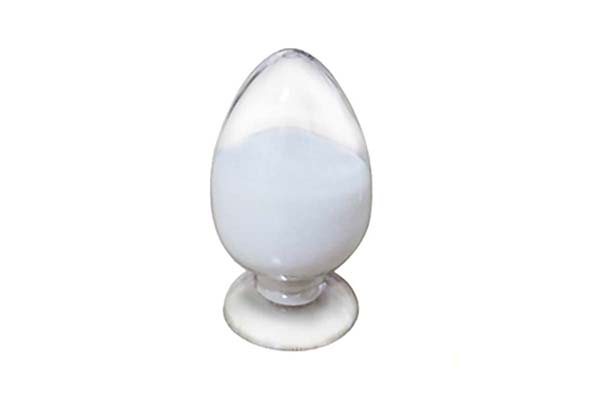
It is produced from cellulose through chemical modification and is supplied as a white or off-white powder.
Construction-grade HPMC is commonly incorporated into cement-based and gypsum-based dry-mix formulations where controlled rheology and water retention are required.
When dispersed and dissolved in water, HPMC increases the viscosity of the aqueous phase and influences water movement within the mortar system.
These characteristics explain why HPMC has become an important raw material in modern dry-mix construction formulations.
What Does HPMC Do in Dry-Mix Mortar?
HPMC performs several functions depending on its grade and dosage.
1. Water Retention
Fresh mortar can lose water rapidly when applied to porous substrates or under warm and dry conditions.
HPMC helps control this water loss and keeps more water available within the mortar for a longer period.
This is particularly important in cementitious formulations where sufficient water is required for cement hydration.
2. Thickening
HPMC increases the consistency of mortar and helps modify its rheological behavior.
Appropriate consistency can improve application characteristics and reduce problems associated with excessively fluid mortar.
3. Workability
The rheological modification provided by cellulose ether can influence spreading, troweling and general handling characteristics.
However, the desired rheology varies considerably between products.
A tile adhesive and a self-leveling compound, for example, require very different flow behavior.
4. Application Time
By controlling water retention and fresh-mortar behavior, HPMC can influence the usable working characteristics of certain construction formulations.
The actual result depends on the complete formulation rather than HPMC alone.
Main Applications of Construction-Grade HPMC
HPMC for Tile Adhesive
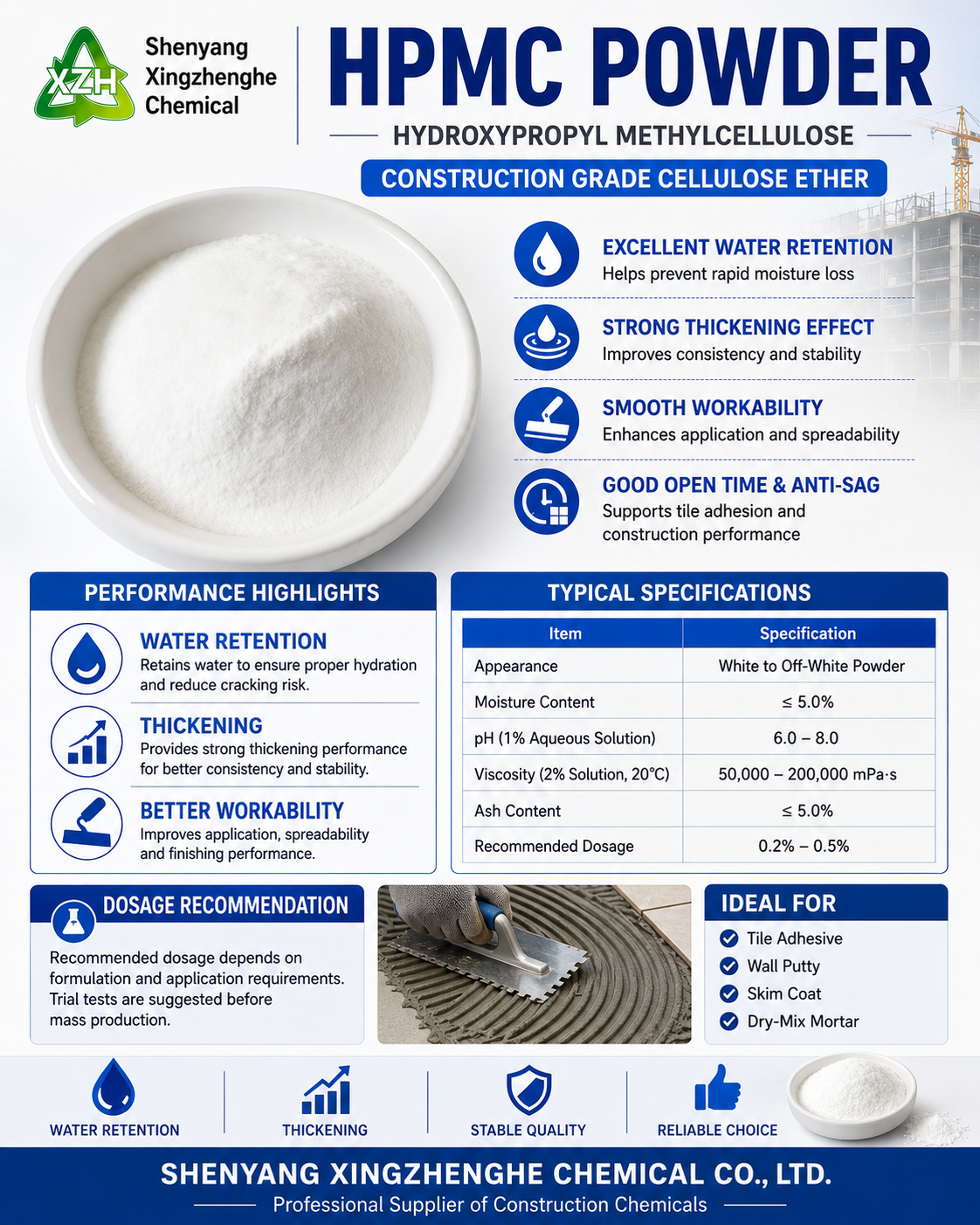
Tile adhesive is one of the major applications of construction-grade HPMC.
In cement-based tile adhesive formulations, HPMC is primarily used to provide water retention, appropriate consistency and workable application characteristics.
The final HPMC grade should be selected together with other raw materials such as cement, aggregates and redispersible polymer powder.
HPMC for Wall Putty
HPMC can be used in wall putty formulations to modify consistency, water retention and application properties.
The required viscosity depends on the formulation and the desired application behavior.
HPMC for Cement Mortar
In cement-based plastering, masonry and repair mortars, HPMC can help maintain moisture and adjust the rheology of the fresh mortar.
This can be particularly useful when the mortar is applied to absorbent substrates.
HPMC for Gypsum-Based Products
Cellulose ethers are also used in gypsum plaster and related formulations.
The appropriate product characteristics may differ from those required for cement-based systems, so product selection should be based on application testing.
HPMC for Self-Leveling Compounds
Self-leveling formulations require controlled viscosity without excessively restricting flow.
For this reason, HPMC selection for self-leveling materials requires particular attention to viscosity and dosage.
How to Choose HPMC Viscosity
Viscosity is one of the most frequently discussed specifications of HPMC, but it should not be considered independently.
Commercial construction-grade HPMC is available across a wide viscosity range.
Higher viscosity does not automatically mean better performance.
The suitable viscosity depends on:
Type of dry-mix mortar
Required water retention
Desired consistency
Application method
Cement and filler system
Other additives in the formulation
For example, a high-viscosity cellulose ether may be appropriate for one mortar formulation but produce excessive thickening in another.
Laboratory formulation testing is therefore recommended before determining the final grade and dosage.
HPMC and RDP: Are They the Same?
HPMC and Redispersible Polymer Powder (RDP) are both widely used in dry-mix mortar, but they perform different functions.
HPMC primarily contributes to water retention, thickening and rheology control.
RDP is a polymer modifier commonly used to improve properties such as adhesion and flexibility.
In products such as tile adhesive, the two materials may be used together because their functions are complementary rather than interchangeable.
HPMC and Polycarboxylate Superplasticizer
HPMC and Polycarboxylate Superplasticizer (PCE) are also fundamentally different construction chemical additives.
PCE is mainly used as a dispersing and water-reducing component in concrete, cementitious systems and certain specialized mortar formulations.
HPMC is primarily a cellulose ether used for water retention and rheology modification.
Understanding this distinction is important when designing a construction chemical formulation.
What Should Buyers Check When Purchasing HPMC?
HPMC should not be evaluated only by product name or nominal viscosity.
Depending on the application, buyers may also consider:
Viscosity and testing method
Moisture content
Ash content
pH
Particle size
Water retention performance
Dissolution characteristics
Consistency between production batches
Compatibility with the intended formulation
A sample test using the buyer's actual cement, filler, polymer powder and other raw materials provides considerably more useful information than comparing specifications alone.
HPMC as Part of a Construction Chemical Formulation
Modern dry-mix mortars are multi-component systems.
A tile adhesive formulation, for example, may contain cement, graded aggregates, HPMC, redispersible polymer powder and additional functional additives.
Each raw material performs a different role.
For this reason, successful HPMC selection requires understanding not only the cellulose ether itself but also how it interacts with the overall formulation.
Shenyang Xingzhenghe Chemical Co., Ltd. supplies functional raw materials for construction chemical formulations, including HPMC, redispersible polymer powder, polycarboxylate superplasticizer and lignosulfonates.
Our approach to product selection focuses on the actual application, formulation requirements and compatibility of different construction chemical additives.